Hey everyone, I haven't had a ton of time to write recently, but I'm still constantly thinking and reflecting!
One of my recent contemplations is on expectations and standards:
What kinds of expectations do I hold for my students? What standards do I use to guide my planning?
The tricky part is, as I have reflected in an earlier post, my students struggle with the English language and with culture as well. For instance, we recently sang a bunch of Christmas songs and danced to movements from the Nutcracker; they will not know its cultural significance unless we set it aside and discuss it. Or, whenever we sing songs, I have to break it down for them so that they know what exactly they're singing about.
To once again describe my job in a nutshell: I am expected to bring a Westernized music education to Chinese students who have had little to no prior "Western" cultural experiences.
Thus, educational standards from Western countries are null; we cannot expect a 1st grader in China to perform in the same way that a 1st grader in the US would do. (Reminder, our school is not an international school for expats; it is open to ordinary Chinese kids) Adjustments must be made.
In my mind, bilingualism plays a HUGE role in such a context, as I could help kids connect their prior knowledge (all in Chinese - their main mode of communication/understanding) to create new meaning. Then this begs the question: what do I do if my administrators tell me to only speak English in class?
To be completely honest, I have been "cheating," because if I want my students to fully understand, I have to be able to communicate with them. If they can use their main mode of communication/understanding in order to create new meaning in English, then that's what I will do.
And maybe that's what constructivism is: to help my students create new meaning by respecting where they're coming from (and Scaffolding from there); take a chill pill in the meantime, because shoving everything down their throats and expecting instant results isn't going to help them.
Tuesday, December 29, 2015

Wednesday, November 18, 2015
Scaffolding Creativity
Goal: To teach students to take a creative/generative approach to music (to "synthesize" and not just "regurgitate.")
Problems:
Now, how do I apply my own problem-solving skills to try and achieve the goal?
Solutions and words to remember (Contemplation):
Problems:
- When left in an unstructured environment, students go berserk or do not know how to respond
- Students do not have enough concrete musical experiences to draw upon when making musical choices (Can't just tell kids: "Go and create!" - Create WHAT? And how?)
- Creativity and problem solving is not part of the cultural context.
Now, how do I apply my own problem-solving skills to try and achieve the goal?
Solutions and words to remember (Contemplation):
- Give students more concrete musical experiences (sing more songs, play more musical games, etc.)
- Provide a strong structure to guide learning, produce flow, and provide predictability.
- Think of creativity in different forms, such as choices made in in musical games.
- Get instruments to use as tools/aids for creativity and play (have been ordered and are now on the way!!)
- Simplify activities and take small steps at a time.
- Remember that learning is a process. It takes TIME. In a couple of years, a school culture will develop.
And yes, that is the interesting thing about my situation; since the school is completely new, there are a lot of things that seem impossible to achieve at this point, but I have to keep reminding myself that after a structure and school-culture is in place, the only ones who really need to ease into it will be the newcomers, and they will have a much easier time as they will see the older children as examples. In the meantime, everyone's a newcomer. And that is ok; I just need to adjust my expectations!
Saturday, November 7, 2015
Finding Happiness
I felt compelled to write this blurb after being reminded in a good talk with a friend/colleague during break in October:
At this point in life, I have gone beyond schooling and am supposedly free to do what I like. I have a well-paying job and am constructing a music program from scratch. Yet, I am not fully satisfied.
Well, what do I even do with my time, or free time for that matter?
For some reason I feel the "need to be productive" and focus on work in my free time, as I had been doing for the past several years. I would also like to do other things, but cannot motivate myself to do so. I have recently been asking myself: what happened to the joy of playing a great video game, reading a novel, taking a walk, playing music for enjoyment, talking with people (NOT about work), or creating things?
I feel like I'm going nuts.
I introduced the song "Simple Gifts" (a Shaker song) to my 7th graders - I think the lyrics may speak some truth in light of this craziness:
Here's a beautiful rendition/cover done by The Piano Guys - hope you'll enjoy it :)
You cannot wait for others to hand happiness to you; you have to be proactive and find what makes YOU happy. And ALLOW yourself to BE HAPPY.Things have been difficult as I am now removed from the structure of being schooled and the drive to achieve (grades, degrees, etc.). School is tough in the sense that you bring work home in the form of studying, writing papers, or reading; it always looms overhead.
At this point in life, I have gone beyond schooling and am supposedly free to do what I like. I have a well-paying job and am constructing a music program from scratch. Yet, I am not fully satisfied.
Well, what do I even do with my time, or free time for that matter?
For some reason I feel the "need to be productive" and focus on work in my free time, as I had been doing for the past several years. I would also like to do other things, but cannot motivate myself to do so. I have recently been asking myself: what happened to the joy of playing a great video game, reading a novel, taking a walk, playing music for enjoyment, talking with people (NOT about work), or creating things?
I feel like I'm going nuts.
I introduced the song "Simple Gifts" (a Shaker song) to my 7th graders - I think the lyrics may speak some truth in light of this craziness:
'Tis a gift to be simple, 'tis a gift to be free
'Tis a gift to come down where we ought to be,
And when we find ourselves in the place just right,
'Twill be in the valley of love and delight.
When true simplicity is gained,
To bow and to bend we shan't be ashamed,
To turn, turn will be our delight,
Till by turning, turning we come 'round right.
Here's a beautiful rendition/cover done by The Piano Guys - hope you'll enjoy it :)
Friday, October 2, 2015
On Relatives and Struggling to Belong (or: Setting Boundaries)
Hi everyone! I'm currently on break due to a National Holiday, and during this time I had the chance to hang out with some of my relatives.
Relatives! According to Google, "relative" comes from the Latin word "relativus," meaning "having reference or relation," as well as the English word "relate."
As welcoming as these relatives are, I feel that I cannot fully "relate" to them. I have noticed:
Relatives! According to Google, "relative" comes from the Latin word "relativus," meaning "having reference or relation," as well as the English word "relate."
As welcoming as these relatives are, I feel that I cannot fully "relate" to them. I have noticed:
- There are many observed habits that my "Western side" finds uncomfortable (i.e. shouting across a restaurant to tell the waitress that she missed an order).
- There are many social and conversational "givens," especially when they all interact with each other. As they take part in the "in group," I feel left out; I am an outsider.
- There are many things they want to do for me to show their hospitality and care, but sometimes I simply want to say: "No, thank you (Please give me some space)."
This isn't all bad though! My struggling to belong is great for a couple reasons:
- I have the chance to learn more about Chinese culture.
- I will learn more about myself and what I believe in throughout this process.
At the root, I am learning to form boundaries; I am giving definition to myself and all components of myself (Philosophy, beliefs, etc.), which, as a young adult trying to figure out life, I find very exciting! (And it is something I will happily partake in)
Will my relatives and I ever "relate" to each other? I have an inkling that we will never reach complete understanding, and maybe that is ok, because that's the basic reality: we are different.
P.S. I just skimmed the wikipedia article that I linked to "boundaries" above - it's fascinating (and very much related to this post)! Please give it a skim when you have the time :)
Will my relatives and I ever "relate" to each other? I have an inkling that we will never reach complete understanding, and maybe that is ok, because that's the basic reality: we are different.
P.S. I just skimmed the wikipedia article that I linked to "boundaries" above - it's fascinating (and very much related to this post)! Please give it a skim when you have the time :)
Tuesday, September 29, 2015
Could Discipline, Structure, Independence, and Creativity Coexist?
Recently I've been thinking a lot about childrens' need for structure; structures allow kids to know if they're doing well in class; it also lets students know what to expect - it makes class feel safer and more predictable. Through structures, kids become "cultured" (they learn what behaviors are acceptable or not).
Yet, I also read "School as the Product of the Adult Fantasy of a World Without Children" (from I'm Only Bleeding, Alan A. Block), which describes how education smothers the imaginative, playful aspect of childhood. This goes hand in hand with one of my favorite books, The Little Prince (Antoine de Saint-Exupéry), which juxtaposes the perspective of the adult (rigid, calculated, stressed) with the perspective of the child (innocent, hopeful, fresh). While in graduate school with no real teaching experience, I veered on the side of emphasizing creativity/free-thought/less-structured (somewhat idealistic, to say the least) - I dreamed of leading classes based on open-projects and Socratic seminars (the language barrier does not help in this area, haha).
However, at this point in time, I feel that I'm beginning to see the need for MORE structure: I have encountered an episode where I was stressed and appalled by the way my middle school students behaved (I was supervising them when they had some free-time; it was like a battle royale - kids yelling at each other, then screaming louder to try getting their way, lots of pushing and shoving, defacing property that isn't theirs, etc.); this was weeks after "telling" them that they are expected to respect the teacher, the space, and their peers.
Respect, as most of the "foreign teachers" know it, does not seem to exist in these students' lives.
As we're preparing our students for a Western-style education--and as I have reflected with countless colleagues--these students do not seem capable of having free-time without unleashing pandemonium. In other words, they NEED structure to keep them in place and for them to channel their creativity and energies in more productive ways. For example I had to teach a lesson to my 7th graders on how to rehearse (step by step!) because they did not know how to do it on their own; when left on their own, they goofed off.
Perhaps this is where we could apply the concept of Parker Palmer's paradox (The Courage to Teach): there are many situations where two seemingly opposite sides exist. Structure is necessary, but it is meaningless without the creative/free component (freedom within structure).
Could Discipline, Structure, Independence, and Creativity Coexist? Yes - in fact, they must!
Yet, I also read "School as the Product of the Adult Fantasy of a World Without Children" (from I'm Only Bleeding, Alan A. Block), which describes how education smothers the imaginative, playful aspect of childhood. This goes hand in hand with one of my favorite books, The Little Prince (Antoine de Saint-Exupéry), which juxtaposes the perspective of the adult (rigid, calculated, stressed) with the perspective of the child (innocent, hopeful, fresh). While in graduate school with no real teaching experience, I veered on the side of emphasizing creativity/free-thought/less-structured (somewhat idealistic, to say the least) - I dreamed of leading classes based on open-projects and Socratic seminars (the language barrier does not help in this area, haha).
However, at this point in time, I feel that I'm beginning to see the need for MORE structure: I have encountered an episode where I was stressed and appalled by the way my middle school students behaved (I was supervising them when they had some free-time; it was like a battle royale - kids yelling at each other, then screaming louder to try getting their way, lots of pushing and shoving, defacing property that isn't theirs, etc.); this was weeks after "telling" them that they are expected to respect the teacher, the space, and their peers.
Respect, as most of the "foreign teachers" know it, does not seem to exist in these students' lives.
As we're preparing our students for a Western-style education--and as I have reflected with countless colleagues--these students do not seem capable of having free-time without unleashing pandemonium. In other words, they NEED structure to keep them in place and for them to channel their creativity and energies in more productive ways. For example I had to teach a lesson to my 7th graders on how to rehearse (step by step!) because they did not know how to do it on their own; when left on their own, they goofed off.
Perhaps this is where we could apply the concept of Parker Palmer's paradox (The Courage to Teach): there are many situations where two seemingly opposite sides exist. Structure is necessary, but it is meaningless without the creative/free component (freedom within structure).
Could Discipline, Structure, Independence, and Creativity Coexist? Yes - in fact, they must!
Saturday, September 19, 2015
Identity Crisis: Asian, American, Musician, Educator
Lately I've been feeling conflicted as there are many things that go unspoken while interacting with students, other parents, and teachers in China. It has been challenging for me to stand firm in what I believe in; if I don't stand firm, I fail to be the teacher and person that I want to be. Here are a few of my observations (conflicts):
- Many Chinese kids AND adults cannot believe that I'm from America; I am Asian [Taiwanese] American. The externalized attempt to comprehend usually goes like this: "Your Chinese sounds off, but I can still talk with you and you know what I am saying...you look Chinese...but you say you're American...how come you're not white? You can't be American..." I find conversations like this to be amusing.
- When I tell others (Chinese relatives, other parents, the Chinese teachers, etc.) that I am a music teacher, they usually follow-up by asking me: "What kind of music do you teach? Will you teach them to play the piano - maybe sing?" All I can do is nod and smile. I don't have the vocabulary to tell them the philosophical underpinnings of what I do, so I just tell them those are possibilities.
- When I tell people my Chinese name (汤耀中 - Tāng Yào Zhōng), I usually explain what each character represents (it's the Chinese way of introducing names). "Tāng as in soup - this is my surname. Yào as in glorify. Zhōng as in, the character used in China; middle; center." And everybody's immediate response is, "Great! You're bringing glory to China!" Boy, does this gets on my nerves! I have revised the last part of my explanation and taken China out of it.
- I feel that my fellow foreign teachers are able to get away with more as they are unable to speak to many of the Chinese teachers. Moreover, they look and act different enough that they are acknowledged and accepted as "different." On the other hand, since I can speak and hear Chinese, I have realized how much I disagree with the Chinese way of doing things in conversations and as I overhear others' conversations. It's a strange dilemma: I want to connect, yet, the more I connect the more I feel uncomfortable; part of me wishes to remain oblivious.
- My elementary students were confused as I played musical games with them last week: "How is this music class?" The students here are used to drilling, reciting, and sitting at desks (some of the Chinese teachers are still doing this as they teach, even if it conflicts with the school's mission statement). I guess this is just something that needs to be worked on one step at a time.
- The Chinese view music as something that only the talented and focused few can do (and music class is only about the talent and skill); it is exclusive. I am trying to make music accessible to everyone. These two frames of mind do not gel together very well. (I am working with a few Chinese music teachers - I foresee this being particularly difficult to navigate)
The big questions: what does it mean for me to stay true to myself? What is my role as a teacher within a larger school system: to be a follower, or a leader? How do I navigate through a world where I don't really belong?
I was hired by the "international principal," an alumna of Teachers College, to bring the Western perspective of music (or, to bring Western education and philosophy through music), yet I feel that I am situated in a context where all odds are against me. At the same time, I'd like to believe that Teachers College has prepared me to stand for myself, stay grounded in theory and philosophy, and to likewise help students find their individual "voices." I know Teachers College tends to raise leaders and advocates in their fields; I believe I am now in a position to slowly bring change to the culture here (the foreign/international administrators are, in fact, encouraging me to do so). The thought of this both excites and terrifies me.
I was hired by the "international principal," an alumna of Teachers College, to bring the Western perspective of music (or, to bring Western education and philosophy through music), yet I feel that I am situated in a context where all odds are against me. At the same time, I'd like to believe that Teachers College has prepared me to stand for myself, stay grounded in theory and philosophy, and to likewise help students find their individual "voices." I know Teachers College tends to raise leaders and advocates in their fields; I believe I am now in a position to slowly bring change to the culture here (the foreign/international administrators are, in fact, encouraging me to do so). The thought of this both excites and terrifies me.
God, help me.
Wednesday, September 16, 2015
Great Eats: 花中城 (Huā Zhōng Chéng - Flower City)
This post was meant to be completed a couple weeks ago, apologies for the slight delay. With that said:
花中城 (located in Shangcheng, Hangzhou) has many affordable but delicious options ranging from desserts to seafood, and everything else. This 11-part meal ended up costing only ~$30 (US)! My relatives originally brought me here during my first week in Hangzhou; turns out my coworkers come here often too since it's so close to our school!


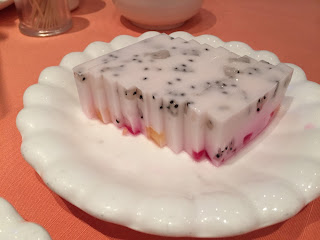


花中城 (located in Shangcheng, Hangzhou) has many affordable but delicious options ranging from desserts to seafood, and everything else. This 11-part meal ended up costing only ~$30 (US)! My relatives originally brought me here during my first week in Hangzhou; turns out my coworkers come here often too since it's so close to our school!


A dessert dish (a fruit jelly)


Fried shrimp cakes - this was one of my favorites!


Standard greens


Fried taro pastry - a tasty dessert!


Hangzhou duck - another great dish!


String Beans


Some kind of Fish from Hangzhou


More fish


A Hangzhou soup with three "rarities"


"Tofu skin" - another tasty option (I grew up eating this)!

Didn't get the name off the menu, but this is basically a steamed cake - very spongy
Subscribe to:
Posts (Atom)